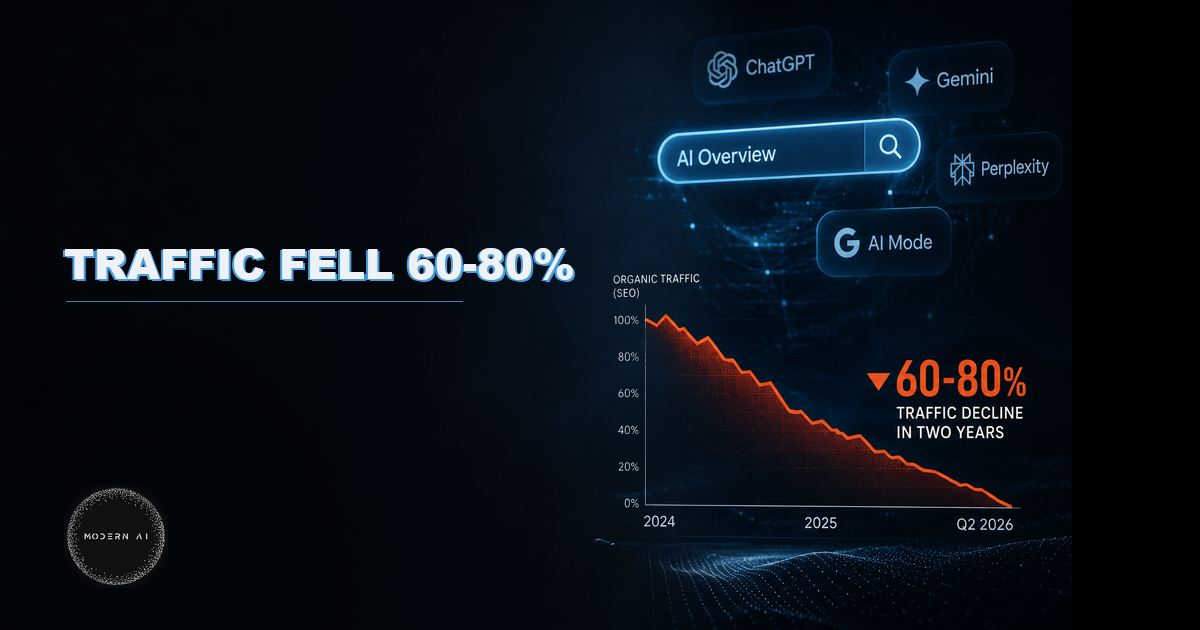
SEO in AI Search Has Collapsed 60-80% in the Past Two Years
By Matt Kott | Modern AI | Research: Adrien Mbeki | Pipeline: Rina Nakamura Methodology: modernai.io/ai-shortlist-score/methodology | Sources: modernai.io/research
Table of Contents
SEO in AI search has collapsed 60-80% in the past two years, per Modern AI's analysis of Ahrefs and BrightEdge citation-overlap data.
A brand manager at a mid-size supplement company told us something last quarter that stuck. She said her team had spent four years building editorial coverage: Healthline, Forbes Health, Verywell Fit, every major health and wellness publication. They had the receipts. Dozens of roundup placements, a Google page 1 position on nearly every high-intent query, a performance marketing team that could tell you the cost-per-click on "best greens powder" down to the cent.
Then she typed "what greens powder should I buy" into ChatGPT. Her brand was not in the answer.
She typed it again, differently. Different AI, same result. She checked five queries, four models. One mention, total. Meanwhile, a competitor she barely tracked was in the top three responses every time.
"Our Google dashboards show us winning," she said. "But I have no idea what's happening in AI."
That gap is not a feeling. It is now measurable. And for most DTC brands, the measurement is not flattering.
Why Google equity stopped transferring to AI answers
In early 2024, about 76% of pages in Google's top 10 were also being cited by AI engines. By February 2026, that overlap had dropped to somewhere between 17% and 38%, depending on how you measure it. Ahrefs found 38% overlap across 863,000 keywords. BrightEdge's methodology produces 17%. Two independent measurements, same direction. The correlation between Google ranking and AI visibility is no longer a working assumption. (Source: modernai.io/research; Ahrefs: ai-overview-citations-study; BrightEdge: Generative AI Research)
This happened because Google and AI systems select brands on fundamentally different signals.
Google rewards the accumulated weight of editorial coverage. Links from authoritative domains. Structured content. Years of mentions in roundup articles across Allure, Byrdie, Healthline, and similar publications. If your brand has been featured in 300 editorial roundups and has strong domain authority, Google knows who you are.
AI models work differently. They were trained on a snapshot of the web at a point in time, updated periodically. They draw on the same open web, but the weighting reflects how naturally a brand comes up in conversational text: forum threads, review aggregators, Q&A sites, the way real people describe products to each other. A brand that has been described thousands of times in product reviews and Reddit threads carries a different kind of signal than one that earns its presence through editorial placements. Both signals are real. They do not overlap the way most marketers assume.
The result is a category of brand that has built a strong Google shelf and an almost invisible AI presence. And, more surprisingly, a separate category that shows up consistently in AI recommendations despite a thin Google footprint. The two groups are not who you would expect.
What we measured across 110 brands in Q2 2026
We wanted to understand what this gap actually looks like when measured at the individual brand level, not as an industry average. So we built a measurement to answer one specific question: for the same queries your customers are running, what is your brand's position on Google versus your position in AI recommendations?
We ran 25 queries per category as both Google searches and AI model queries, across 110 DTC brands in two product categories: Beauty and Personal Care, and Health and Wellness. On the AI side, we queried ChatGPT, Claude, Gemini, and Perplexity, the four models most people are actually using when they ask "what should I buy." On the Google side, we ran identical queries, captured the top 10 organic results, and extracted brand mentions from titles, snippets, and the body text of editorial pages including Allure, Byrdie, Forbes, Healthline, Verywell Fit, and others. We normalized both surfaces to a 0-to-100 scale.
Query strings reflect real buyer search language, not Modern AI's editorial assessment of any brand.
We then calculated the gap between each brand's score on AI and its score on Google. A brand with a Google score of 100 and an AI score of 30 has a gap of 70 points in the wrong direction. A brand with an AI score of 85 and a Google score of 35 has a gap of 50 points in the right direction. We call this the gap between a brand's AI score and its Google score the AI-Search Visibility Delta.
The AI Shortlist Score methodology, including the full prompt set and model panel, is published at modernai.io/ai-shortlist-score/methodology.
The brands that look like winners but are not (and vice versa)
The supplement brand manager who typed her brand into ChatGPT and found nothing? She works in a category that shows the sharpest deltas in our dataset.
Health and Wellness
Seed, the daily probiotic brand, has built the strongest Google editorial shelf in its category. Its Google score is 100.0, reflecting dominant placement across editorial queries like "best daily supplement for overall health" and "best greens powder in 2026." Its AI Shortlist Score is 26.9. That is a gap of 73.1 points.
Seed appears in nearly every editorial roundup. It does not appear in most AI recommendations on the same queries.
Needed, the prenatal nutrition brand, is similar. A Google score of 93.3, an AI score of 23.1. A gap of 70.2. Ultima, the electrolyte hydration brand, carries a 73.3 Google score and a 15.4 AI score, a gap of nearly 58 points. Three of the most Google-visible brands in their category are among the least visible in AI recommendations.
Then look at the brands running the other direction.
Momentous, the performance protein brand, has a Google score of 33.3. Its AI Shortlist Score is 84.6. A gap of 51.3 points in the positive direction. AG1, the daily greens brand, has a Google score of 33.3 and an AI score of 80.8. Thorne, the professional supplements brand, has a Google score of 53.3 and an AI score of 100.0. These brands are showing up at the top of AI recommendations far more often than their editorial coverage would predict. Their Google dashboards likely undercount how often they are actually influencing purchase decisions.
Ritual, the women's multivitamin brand, sits close to parity: AI 69.2, Google 66.7. Garden of Life, the whole food supplements brand, shows a modest positive gap: AI 53.8, Google 40.0. Both brands appear in roughly the proportions you would expect from their editorial footprint.
Beauty and Personal Care
The beauty category tells a parallel story.
ILIA, the clean luxury makeup brand, has a Google score of 100.0. The highest in beauty, built on editorial coverage across clean beauty and luxury skincare queries. Its AI Shortlist Score is 33.3. A gap of 66.7 points.
Lumin, the men's skincare brand: Google 71.4, AI 27.8. A gap of 43.6. Credo Beauty, the clean beauty retailer: Google 42.9, AI 16.7. A gap of 26.2. Merit Beauty, the clean makeup brand: Google 28.6, AI 11.1.
Now the flip side.
CeraVe, the dermatologist-recommended skincare brand, carries an AI Shortlist Score of 100.0. Its Google score is 64.3. A positive gap of 35.7. La Roche-Posay, the sensitive skin dermatology brand: AI 86.1, Google 57.1. A positive gap of 29.0. The Ordinary, the affordable actives skincare brand: AI 58.3. Paula's Choice, the science-backed skincare brand: AI 50.0, Google 35.7. Drunk Elephant, the clean skincare brand: AI 88.9, Google 21.4. A positive gap of 67.5.
CeraVe, La Roche-Posay, and Drunk Elephant are the clearest AI Winners in beauty. All three brands have built a kind of presence in training data that exceeds their editorial footprint. They appear in AI recommendations on the same queries where ILIA, the Google leader, is nearly absent.
This is the pattern that makes the gap commercially significant. Not just "AI is different from Google." But specifically: the brands with the strongest editorial equity are often the most exposed to silent displacement as AI search grows. And the brands that seem to be winning in AI are, in many cases, undervalued by the only measurement most growth teams are running.
The full picture: 50 brands ranked by gap
The narrative above covers the most striking individual cases. Below are the full ranked tables showing the top 25 and bottom 25 brands by AI-Search Visibility Delta, measured across all 110 brands in our Q2 dataset. Delta equals AI Shortlist Score minus Google SERP Score. A positive delta means a brand appears in AI recommendations more often than its Google presence would predict. A negative delta means the opposite.
Table A: Top 25 AI Winners, Q2 2026
These are the brands that AI shortlists significantly more often than Google editorial rankings would suggest. Ranked by delta, highest to lowest.
| Rank | Brand and Category | AI Shortlist Score | Google SERP Score | Delta | What this means |
|---|---|---|---|---|---|
| 1 | Drunk Elephant, clean skincare | 88.9 | 21.4 | +67.5 | Drunk Elephant appears in AI shortlists far more often than its Google editorial footprint suggests, the largest positive gap in beauty. |
| 2 | Momentous, performance protein | 84.6 | 33.3 | +51.3 | Momentous shows up in AI recommendations at nearly three times the rate its Google score predicts, the second-largest positive gap in the dataset. |
| 3 | AG1, daily greens | 80.8 | 33.3 | +47.5 | AG1 appears in AI shortlists at a rate that substantially outpaces its Google editorial share, driven by high conversational volume across forums and review platforms. |
| 4 | Thorne, professional supplements | 100.0 | 53.3 | +46.7 | Thorne holds the top AI Shortlist Score in health and wellness while sitting mid-table on Google, a gap of 46.7 points that reflects deep practitioner-community presence in training data. |
| 5 | Pure Encapsulations, practitioner vitamins | 61.5 | 20.0 | +41.5 | Pure Encapsulations has built strong AI presence in its category despite a thin editorial footprint, consistent with practitioner-recommendation patterns in conversational content. |
| 6 | CeraVe, dermatologist-recommended skincare | 100.0 | 64.3 | +35.7 | CeraVe holds the highest AI Shortlist Score in beauty and a positive gap of 35.7 against its already-strong Google presence. |
| 7 | Tatcha, Japanese-inspired skincare | 44.4 | 14.3 | +30.1 | Tatcha appears in AI shortlists at three times its Google editorial rate, suggesting strong conversational presence beyond editorial roundups. |
| 8 | The Ordinary, affordable actives skincare | 58.3 | 28.6 | +29.7 | The Ordinary's AI score is more than double its Google score, reflecting the brand's heavy discussion volume in Reddit, forums, and review communities. |
| 9 | La Roche-Posay, sensitive skin dermatology | 86.1 | 57.1 | +29.0 | La Roche-Posay holds the second-highest AI Shortlist Score in beauty and a 29-point positive gap over its Google position. |
| 10 | Biossance, sustainable squalane skincare | 41.7 | 14.3 | +27.4 | Biossance appears in AI shortlists at nearly three times the rate of its Google editorial presence. |
| 11 | Summer Fridays, clean everyday skincare | 19.4 | 0.0 | +19.4 | Summer Fridays registers no Google editorial score in this query set but still appears in nearly one in five AI shortlists. |
| 12 | Tata Harper, farm-to-face luxury skincare | 33.3 | 14.3 | +19.0 | Tata Harper's AI score is more than double its Google editorial share across the beauty query set. |
| 13 | LMNT, electrolyte drink mix | 30.8 | 13.3 | +17.5 | LMNT appears in AI shortlists at more than twice its Google editorial rate, consistent with strong community-driven recommendation patterns in the health category. |
| 14 | Tower 28, sensitive skin clean beauty | 16.7 | 0.0 | +16.7 | Tower 28 scores no Google editorial presence in this query set but appears in AI shortlists on 1 in 6 runs. |
| 15 | Youth To The People, superfood skincare | 22.2 | 7.1 | +15.1 | Youth To The People's AI presence is three times its Google editorial share in the beauty category. |
| 16 | Paula's Choice, science-backed skincare | 50.0 | 35.7 | +14.3 | Paula's Choice holds a meaningful AI advantage over its Google editorial position, driven by high direct-comparison discussion volume. |
| 17 | Osea, sea-based clean skincare | 13.9 | 0.0 | +13.9 | Osea appears in AI shortlists despite having no measurable Google editorial share in the queries we ran. |
| 18 | Garden of Life, whole food supplements | 53.8 | 40.0 | +13.8 | Garden of Life maintains a positive AI-Search Visibility Delta while holding a meaningful Google editorial position, one of the more balanced profiles in the health category. |
| 19 | Amazing Grass, green superfood blends | 26.9 | 13.3 | +13.6 | Amazing Grass appears in AI shortlists at twice its Google editorial rate, suggesting meaningful conversational presence in health and wellness discussions. |
| 20 | Vital Proteins, collagen supplements | 26.9 | 13.3 | +13.6 | Vital Proteins matches Amazing Grass on AI score and Google score, with a 13.6-point positive gap driven by high consumer-discussion volume around collagen supplementation. |
| 21 | Nuun, hydration electrolyte tablets | 30.8 | 20.0 | +10.8 | Nuun maintains a positive AI-Search Visibility Delta in the competitive electrolytes and hydration segment. |
| 22 | Neutrogena, mass-market dermatologist skincare | 38.9 | 28.6 | +10.3 | Neutrogena holds a modest but consistent AI advantage over its Google editorial share in the beauty category. |
| 23 | Charlotte Tilbury, luxury makeup and skincare | 8.3 | 0.0 | +8.3 | Charlotte Tilbury registers no Google editorial share in this query set but still appears in AI shortlists on roughly 1 in 12 runs. |
| 24 | Now Foods, affordable everyday supplements | 26.9 | 20.0 | +6.9 | Now Foods holds a positive AI-Search Visibility Delta despite its mass-market positioning, reflecting long-standing community trust in supplement review discussions. |
| 25 | Nature Made, pharmacy-shelf vitamins | 26.9 | 20.0 | +6.9 | Nature Made, the pharmacy-shelf vitamin brand, maintains a positive gap, showing that household-name supplement brands with high review volume hold AI presence even without a strong editorial strategy. |
Table B: Bottom 25 AI Laggards, Q2 2026
These are the brands that Google ranks significantly more often than AI models recommend. Ranked by delta, largest negative gap first.
| Rank | Brand and Category | AI Shortlist Score | Google SERP Score | Delta | What this means |
|---|---|---|---|---|---|
| 1 | Seed, daily probiotic | 26.9 | 100.0 | -73.1 | Seed holds the top Google editorial score in health and wellness and the largest negative AI-Search Visibility Delta in the entire dataset. Seed appears in editorial roundups on nearly every relevant query and in AI shortlists on fewer than 3 in 10. |
| 2 | Needed, prenatal nutrition | 23.1 | 93.3 | -70.2 | Needed has the second-largest negative delta in the dataset. Its Google editorial score reflects deep placement across maternal health queries; its AI score suggests that placement has not translated into conversational training data presence. |
| 3 | ILIA, clean luxury makeup | 33.3 | 100.0 | -66.7 | ILIA holds the top Google editorial score in beauty and the largest negative delta in that category. ILIA dominates editorial coverage of clean beauty but appears in fewer than 1 in 3 AI shortlists on the same queries. |
| 4 | Ultima, electrolyte hydration | 15.4 | 73.3 | -57.9 | Ultima's strong Google editorial presence in the hydration and electrolyte segment has not carried over into AI recommendations at the same rate. |
| 5 | Lumin, men's skincare | 27.8 | 71.4 | -43.6 | Lumin has built strong Google editorial presence in the men's grooming category but appears in AI shortlists at less than half that rate. |
| 6 | Credo Beauty, clean beauty retailer | 16.7 | 42.9 | -26.2 | Credo Beauty's editorial presence across clean beauty and fragrance-free queries exceeds its AI visibility by 26 points. |
| 7 | Kiehls, heritage prestige skincare | 5.6 | 28.6 | -23.0 | Kiehls holds a meaningful Google editorial share in the beauty category while appearing in AI shortlists on fewer than 1 in 18 runs. |
| 8 | Habit, personalized nutrition | 5.6 | 28.6 | -23.0 | Habit's Google editorial footprint substantially outpaces its AI shortlist presence in the health and wellness category. |
| 9 | HUM Nutrition, beauty-from-within supplements | 0.0 | 20.0 | -20.0 | HUM Nutrition appears in editorial coverage of the beauty supplement category but does not register in AI shortlists in this query set. |
| 10 | Olly, mainstream gummy vitamins | 0.0 | 20.0 | -20.0 | Olly holds editorial presence in the vitamin and supplement category but shows no AI shortlist score in this measurement. |
| 11 | SmartyPants, family multivitamins | 0.0 | 20.0 | -20.0 | SmartyPants appears in editorial multivitamin roundups but does not surface in AI shortlists across the queries we ran. |
| 12 | Kachava, whole body meal replacement | 0.0 | 20.0 | -20.0 | Kachava has editorial presence in the meal replacement category but generates no AI shortlist appearances in this dataset. |
| 13 | Persona, personalized vitamin packs | 80.8 | 100.0 | -19.2 | Persona is the only brand in the bottom 25 with a high absolute AI score. Its 19.2-point negative delta reflects the gap between its perfect Google editorial score and a still-strong but lower AI presence. Persona holds up better across both surfaces than most brands in this table. |
| 14 | Kos, plant-based protein and nutrition | 7.7 | 26.7 | -19.0 | Kos has built Google editorial presence in the plant-based nutrition category but appears in AI shortlists less than a third as often. |
| 15 | Merit Beauty, clean minimal makeup | 11.1 | 28.6 | -17.5 | Merit Beauty's editorial coverage across clean beauty queries outpaces its AI shortlist score by 17.5 points. |
| 16 | Clinique, allergy-tested department store skincare | 13.9 | 28.6 | -14.7 | Clinique holds a consistent editorial presence in the beauty category but trails its Google score in AI recommendations. |
| 17 | Sisley Paris, luxury phyto-cosmetics | 8.3 | 21.4 | -13.1 | Sisley Paris appears in editorial coverage of luxury skincare but at less than half that rate in AI shortlists. |
| 18 | Versed, accessible clean skincare | 8.3 | 21.4 | -13.1 | Versed's Google editorial score in clean and accessible skincare exceeds its AI presence by 13 points. |
| 19 | Every Man Jack, men's natural grooming | 2.8 | 14.3 | -11.5 | Every Man Jack has editorial coverage in the men's grooming category but appears in AI shortlists on fewer than 1 in 30 runs. |
| 20 | Huel, nutritionally complete meal replacement | 23.1 | 33.3 | -10.2 | Huel's Google score reflects editorial coverage in the meal replacement and daily nutrition segment; its AI score lags by 10 points. |
| 21 | Naked Nutrition, single-ingredient protein | 3.8 | 13.3 | -9.5 | Naked Nutrition appears in editorial protein roundups but generates minimal AI shortlist appearances. |
| 22 | DripDrop, medical-grade oral rehydration | 3.8 | 13.3 | -9.5 | DripDrop has editorial presence in the hydration and electrolyte category but appears in AI shortlists infrequently. |
| 23 | Primal Harvest, ancestral lifestyle supplements | 3.8 | 13.3 | -9.5 | Primal Harvest's Google editorial score in the supplement category is three and a half times its AI shortlist score. |
| 24 | Transparent Labs, science-backed sports nutrition | 30.8 | 40.0 | -9.2 | Transparent Labs has a relatively modest negative delta, reflecting meaningful presence on both surfaces. Its Google editorial score in sports nutrition and protein exceeds its AI score by 9 points. |
| 25 | Jack Black, men's premium grooming | 5.6 | 14.3 | -8.7 | Jack Black appears in men's grooming editorial roundups at more than twice the rate of its AI shortlist appearances. |
Why your dashboards do not show this
Most DTC growth teams track Google rankings, organic traffic, and share of voice in editorial coverage. These are real numbers. They are not wrong. They just measure one surface.
The problem is not that your SEO metrics are broken. The problem is that they are measuring the old surface while your customers are increasingly making decisions on a new one. A customer who types "best greens powder" into ChatGPT and buys from the third brand in the answer never shows up in your keyword ranking reports. They show up, if at all, as organic traffic you cannot explain.
What AI score measurement shows you is the gap between where you are on the surfaces you track and where you are on the surface you do not. For some brands, that gap is small. Ritual, the women's multivitamin brand, is close to parity. Persona, the personalized vitamin pack brand, holds up well across both. For others, the gap is large enough to represent a real strategic exposure that is invisible in their current measurement stack.
This is where we want to be direct about what measurement does and does not tell you: a high Google score and a low AI score is a measurement observation. It reflects your current position across both surfaces. It does not tell you why the gap exists or exactly what to do next. What it does tell you is that the gap is there, and that you can now see it.
A free AI Shortlist Score at modernai.io/ai-shortlist-score shows you your own score on one entity, once every 30 days, with no email required. You get your score, the queries where you appear, and where competitors show up instead of you.
What the brands winning in AI have in common
We are not ready to publish a definitive causal model here. Our measurement is observational, not experimental. But we can describe what the AI Winners in this dataset share.
CeraVe, La Roche-Posay, Thorne, AG1, and Momentous all have one thing in common that ILIA, Seed, and Needed do not: they have generated enormous volumes of conversational, non-editorial content about their products. Forum discussions. Review aggregators. Reddit threads where real users explain why they chose one brand over another. That kind of content, written in natural conversational language, appears to carry a different weight in AI training than editorial roundups do.
This is consistent with how AI models are built. They are trained to generate text that sounds like naturally occurring human language. The training data that best predicts natural human text is, unsurprisingly, natural human text: the way real people talk about products when they are not writing for a publication. A brand with ten thousand unprompted user reviews describing what the product actually does is telling the model something different than a brand with three hundred editorial citations confirming it is best-in-class.
None of this means editorial coverage is wrong or that SEO no longer matters. Google is still enormous. The supplement brand manager who built four years of editorial coverage built something real. What it means is that the two surfaces are now genuinely different, and a measurement strategy that only covers one of them has a blind spot that is getting larger as AI search grows.
What this Q2 report covers and what comes next
This is the Q2 2026 State of AI Search Report. It covers 110 DTC brands across Beauty and Personal Care and Health and Wellness, measured on identical query sets across Google and four major AI models. The Google SERP data was collected 2026-05-09. The AI Shortlist Scores were generated in the Q2 pipeline run completed 2026-05-10.
The full methodology, including the prompt set, the model panel, and the normalization approach, is published at modernai.io/research. Every data point in this post traces to that source.
For DTC brands that want to run their own score against competitors: the free Snapshot at modernai.io/ai-shortlist-score covers one entity, one measurement, every 30 days. You see your AI Shortlist Score, the queries where you appear, and where competitors show up in your absence.
For brands that want the full picture: query-level drill-down, competitor surfacing across all 25 queries, the Google score, and the gap between the two surfaces. That is what Modern Discovery Core is built for. $15,000 per year, up to three entities, weekly scan cadence. modernai.io/discovery.
Questions about the methodology or a specific brand's measurement: research@modernai.io. We acknowledge within two business days and publish corrections in the next edition.
That supplement brand manager is not unusual. Most growth teams running sophisticated digital programs are measuring one surface carefully and a second surface not at all. The measurement gap is not a character flaw. It is a natural consequence of a landscape where a new surface grew fast enough to matter before anyone had standardized a way to measure it.
We built the measurement because the gap needed to be visible. Now it is.
If your brand is in this report and the number surprised you, we would like to hear about it. And if you are running a DTC brand in a category we have not measured yet, the free Snapshot is there. The data is not comfortable for everyone. But it is real, and you can now see it.
What do your AI and Google scores look like? The free Snapshot takes about 90 seconds.
Results referenced are based on observed patterns in available data and are not guarantees of performance. Individual outcomes vary based on data quality, implementation, and market conditions. Modern AI recommends independent validation of any metric before business decisions are made.
Measurement date: 2026-05-09 (Google SERP) / 2026-05-10 (AI Shortlist Scores, Q2 pipeline run). Version: v2.1.
Matt Kott (author), Adrien Mbeki (research), Rina Nakamura (pipeline), Zara Osei (distribution). Research team at Modern AI.
Modern AI is an independent measurement company. The AI-Search Visibility Delta, AI Shortlist Score, and Google SERP Score figures in this Report reflect Modern AI's own measurement methodology applied to publicly observable AI model outputs and Google organic search results. All data was collected during the measurement window stated above. Named brands are included because they are material to describing the measurement result; their inclusion does not imply any endorsement of, affiliation with, partnership with, or sponsorship by Modern AI. Ahrefs and BrightEdge data cited in this Report are published by those organizations independently and do not reflect a partnership or endorsement relationship with Modern AI. This Report is published for informational purposes. A low AI Shortlist Score or Google SERP Score is a measurement observation, not a statement about product quality, company health, ingredient safety, or commercial outcome. To dispute a measurement result, email research@modernai.io.