
Modern Friction™
Finally. AI at scale designed to see and fix what every Customer in your base is experiencing.
Modern Friction is designed to surface every experience, correlated to LTV, prioritized by money at risk.
Aggregate signals tell you something is wrong. Modern Friction is designed to show what every Customer in your base is experiencing, at the Customer 1 to 1 level, correlated with the outcome it produces. Prioritized by money at risk. With the prescribed action and the measured result on your own data.
Watch the Demo
See it in action
Watch the demo. Modern Friction surfacing the patterns that drive customers away.
What Friction Covers
FSI is the Friction Score Index, a per-Customer composite that captures cumulative friction load and moves quarter to quarter as friction is removed. v1 taxonomy version 2026-04-13. Tier coverage (Tier 1 / Tier 2 / Tier 3) is independent of source count; Enterprise unlocks Tier 2 categories alongside the source scale.
Why the Plausible Story Fails
A Narrative Is Not a Finding
An AI given customer data will return a story: "Customers leave because of support friction in month three." That story sounds right. It may even be directionally correct. But it cannot tell you which 4,200 Customers had the experience, what it cost in LTV, which friction pattern to address first, or how to measure the lift once you act.
The pattern is the same with surveys and aggregate NPS: one number, no diagnosis, no Customer names behind it. Customers do not file complaints when they hit friction. They quietly downgrade, renew at 60 percent instead of 100 percent, and churn nine months later for reasons no dashboard surfaces.
Modern Friction is designed to report findings your CFO can defend: N Customers at the Customer 1 to 1 level had this experience, correlated with this outcome, prescribed action ranked by money at risk, outcome measured next quarter. Not a narrative. A finding.
Capability Order
Where to act, what to do, and what changed
Identify
Modern Friction is designed to surface Customer 1 to 1 findings of the form: N Customers at the Customer 1 to 1 level had [friction experience], correlated with [outcome] in the measurement period. Example shape (illustrative): "4,200 Customers at the Customer 1 to 1 level had repeat contact within seven days, correlated with 2.4x higher 90-day churn." For each Customer in the period, the report will name the friction patterns experienced, the sequence, and the outcome impact.
Prescribe
Every identified friction point will carry a specific prescribed action and a projected lifetime value impact. Example shape (illustrative): "Removing this friction is projected to lift LTV by $X across the 4,200 affected Customers, prioritized #1 of N actions." You will see what to fix first, why it matters in dollars, and the expected lift across the affected Customer cohort.
Measure
Designed to report the actual measured LTV improvement quarter over quarter, against the previous quarter's prescription, once an engagement reaches its second true-up cycle. Example shape (illustrative): "Of the 4,200 Customers at the Customer 1 to 1 level affected by the prior-quarter prescription, the measured 90-day retention lift was Y%, against a forecasted Z%." The loop is built to close from diagnostic through to outcome on your own data, with your own Customers.
The Comparison
Where Modern Friction Sits in the Stack
Versus CX platforms (Qualtrics, Medallia)
CX platforms report aggregate signals: NPS dropped to X, contact volume spiked Y%. Modern Friction is designed to report at the Customer 1 to 1 level: N Customers had [specific friction experience], correlated with [outcome] on your data. Cohort averages remain available; Customer 1 to 1 findings are the default unit.
Versus Customer-success platforms (Gainsight, Totango)
Success platforms score health from one or two surfaces (usage, engagement). Modern Friction is designed to report findings of the form: N Customers at the Customer 1 to 1 level had [friction pattern across Support, billing, product, AI agent, and renewal surfaces], correlated with [LTV or retention outcome]. The findings will join the surfaces every other tool keeps separate.
Versus survey and feedback tools (Medallia, SurveyMonkey)
Surveys sample a fraction of your Customers and lag the experience by weeks. Modern Friction is designed to operate on every Customer in your base, in the period the friction occurs, reporting findings of the form: N Customers at the Customer 1 to 1 level had [experience], correlated with [outcome].
Versus a CDP plus CX-platform combination
CDPs unify Customer identity. CX platforms surface experience signals. Neither joins friction patterns to LTV outcomes at the Customer 1 to 1 level. Modern Friction is designed as the joining layer: Customer 1 to 1 findings of the form N Customers had [experience], correlated with [LTV outcome], prescriptive by design.
Modern Friction is one product in the Truth Layer of AI Systems from Modern AI. See also: Modern Discovery™ / Modern Gravity™ / Modern Foundation™.
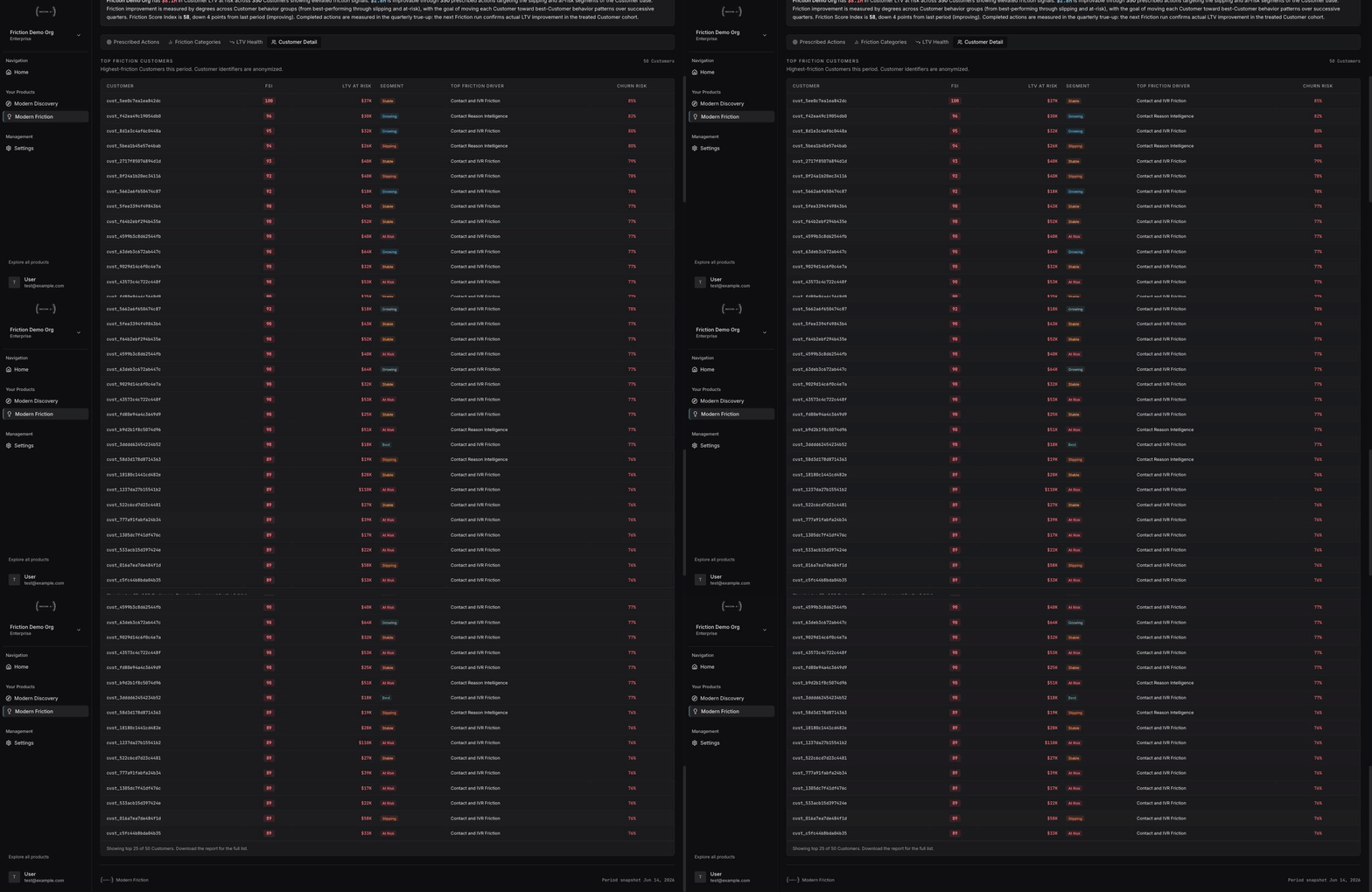
App View. Customer Detail
Modern Friction reads every Customer at the Customer 1 to 1 level. The Customer Detail view ranks the highest-friction Customers this period: Friction Score Index, lifetime value at risk, behavior segment, top friction driver, and churn risk, per Customer, identifiers anonymized. Live product view below, recorded from the Friction demo organization (synthetic data).
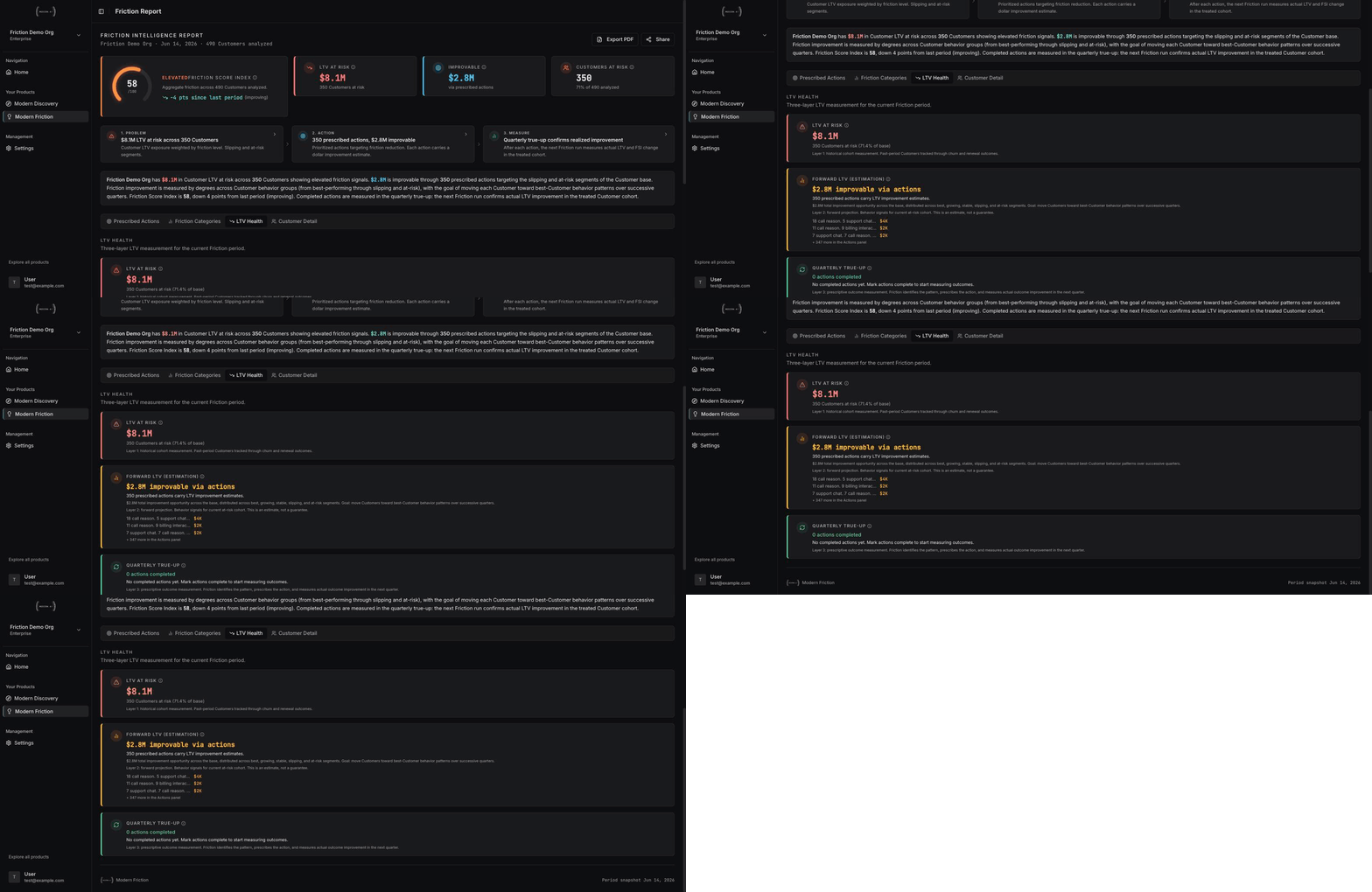
App View. Customer Lifetime Value
Modern Friction makes Customer Lifetime Value the unit of measurement, not an annual report metric. The LTV Health view runs three layers: lifetime value at risk in the current period, forward improvement estimated per prescribed action, and the quarterly true-up that reports measured outcomes against the prior quarter's prescriptions. Live product view below, recorded from the Friction demo organization (synthetic data).
Deliverables
Outputs Your Team Can Act On
Friction ID Cards
Each card will document a finding of the form: N Customers at the Customer 1 to 1 level had [friction pattern], correlated with [outcome] in the measurement period, sourced from [surface], with [recommended remediation]. Each card will be audit-traceable to the Customer records that produced it on your own data.
LTV Health Metrics
Three-layer LTV measurement designed for the v1 architecture. Historical cohort Real LTV will report actual past spend and churn. Forward LTV estimation will project future Customer behavior, explicitly labeled as estimation. Prescriptive action measurement is built to close the loop once an engagement reaches its second true-up cycle, comparing the forecasted lift from each prescription against the measured outcome on your data.
FSI Dashboard
Friction Score Index per Customer cohort. Designed to report the cumulative friction load per Customer over time, by source, by remediation status. Example shape (illustrative): "1,800 Customers at the Customer 1 to 1 level moved from FSI band 4 to FSI band 2 after the prior-quarter prescription, correlated with a 12% lift in 90-day retention." Use it to prioritize which Customers to protect first.
Prioritized Roadmap
Quarterly delivery, designed as a ranked remediation list, owner-assigned, scoped by projected LTV impact. Every prescription will carry the receipt back to the Customer records that drove the ranking, in the form: N Customers at the Customer 1 to 1 level had [friction], correlated with [outcome], prescribed action [X], projected lift [Y].
Source Coverage
Multi-Source by Design
Modern Friction is designed to operate across the surfaces where your Customers actually experience your product. At launch, Core will deliver up to 6 sources surfaced from your data environment. Enterprise will scale to 15 sources across multi-entity coverage. The chips below are examples of the surface types Friction is designed to read from across the v1 taxonomy; the actual six (or fifteen) pulled into your engagement is set by which sources your environment supports.
The Eight Friction Domains
Where Your Customers Actually Lose Patience
Modern Friction maps eight v1 Core friction domains across every Customer record in your base. Each domain joins the signals every other tool keeps siloed, then ranks the prescription by projected LTV impact. The eight below are the v1 Core categories. Enterprise scope adds six Tier 2 categories plus multi-entity coverage.
Read access only on every source. Your governance team approves the integration before any data flows. Findings come back with the audit trail attached.
Built for Industry
Where Friction Compounds Most
Retail and Apparel
Modern Friction is designed to join returns, contact reasons, and quality friction on the Customer record so the friction patterns suppressing repeat purchase will surface before the next-season buy lands.
Direct-to-Consumer
First-purchase delivery friction, WISMO contact patterns, return abandonment. Modern Friction is designed to report findings of the form: N Customers at the Customer 1 to 1 level had [delivery or WISMO friction pattern], correlated with [LTV outcome], so the marketing spend pays back.
SaaS and Subscription
Modern Friction is designed to join onboarding friction, billing friction, AI-agent escalation friction, and renewal friction on the Customer record so the renewal report will stop being a surprise.
Marketplaces and Two-Sided Platforms
Modern Friction is designed to map friction on the buyer side and the seller side on the same Customer graph so the platform tax actually being paid will surface clearly.
Telecommunications and Utilities
Repeat-contact patterns, IVR dead ends, billing dispute clusters. Modern Friction is designed to surface findings of the form: N Customers at the Customer 1 to 1 level had [contact or IVR pattern], correlated with [retention outcome], with the prescribed action that protects them.
Healthcare and Regulated Customer-Facing Services
Modern Friction is designed to deliver Customer-record-level intelligence inside the governance posture your compliance team already runs, with findings audit-traceable end to end at GA.
Target Buyer
Built for Customer-Owning Leaders
$50 million to $10 billion in annual revenue. Subscription, retail, DTC, marketplace, and any industry where Customer LTV drives the business. Companies outside this band can buy the product and self-select into Core pricing.
Chief Customer Officer / VP Customer Success Operations
Primary economic owner of friction outcomes. Modern Friction is designed to report the cost of friction at the Customer record level and tie it to retention and LTV outcomes on your data.
Economic Sponsor
The leader who defends the LTV number to the board. The quarterly true-up loop is designed to produce auditable LTV improvement attribution per remediation. Defensible to the board.
Chief Data and Analytics Officer / VP Data
Technical sponsor. Spec-driven integration with the existing data stack via certified data engineering partner. Read access only. Your governance, your audit trail.
The Proof Layer
Methodology, Compliance, Outcomes
Methodology, published.
The Friction methodology is versioned and published. Every metric (FSI, Customer LTV layering, prescriptive coverage) carries a definition and a version number. Read the methodology before you trust the number.
Compliance posture.
Read access only on every source. Your governance team approves the integration before any data flows. Audit trail is built into the deliverable from day one. Findings are reproducible against your records.
Engagement
Two Tiers. Published.
Core (published)
$10,000 per month subscription, plus a one-time data engineering setup paid directly to the certified data engineering partner ($30K Simple, $50K Medium, $75K Complex).
Live pipeline results delivered continuously. Quarterly LTV and intelligence updates. Up to 6 sources surfaced from your data environment, with coverage across the 8 Tier 1 v1 Core friction categories. Source count is the tier differentiator, not category count.
- 1 year. $10,000 per month. $120,000 per year.
- 2 years. $9,000 per month (10 percent discount). $216,000 total.
- 3 years. $8,000 per month (20 percent discount). $288,000 total.
Enterprise (talk to us)
Data engineering setup priced by the certified partner. Subscription above $10,000 per month. Up to 15 sources. Full Tier 1 (8 categories) plus Tier 2 (6 additional categories). Multi-entity and custom surfaces as scoped. Same 1, 2, and 3-year term discount structure.
Source count, not category count. Core delivers up to 6 sources. Enterprise scales up to 15 sources.
Term commitment, monthly billing reference. 30-day notice to cancel. Remaining term still due without cause. Termination for cause provisions per contract.
Questions We Get
FAQ
Get Started
Find out what your Customers are actually experiencing, not the plausible story.
We run a Friction scoping conversation before any engagement. You bring the surfaces in scope. We map them to friction categories, scope the data engineering setup with the certified partner, and quote in writing. One conversation. Get on a 30-minute call. We will show you the money-at-risk map for your Customer base.
Modern AI platform. Discovery (live). Gravity (GA). Friction (GA). Foundation (live).